
July 2, 2025
DHAKA – Returning to Dhaka last September after five years abroad, I was simply searching for a modest, functional, and affordable cabinet. But as I wandered through the bustling alleys of the Mirpur Stadium furniture market, I found myself entangled in a complex narrative woven from timber, class aspirations, and ecological politics. Amid rows of polished wood and lively chatter, one term repeatedly caught my ear: Jessore teak. It mimicked the elegance of real teak (segun) but was far cheaper. When I asked what tree it came from, most were unsure, until an elderly shopkeeper disclosed the truth: Jessore teak is actually akashmoni (Acacia auriculiformis and Acacia mangium), a fast-growing species that matures in a decade and thrives where little else does.
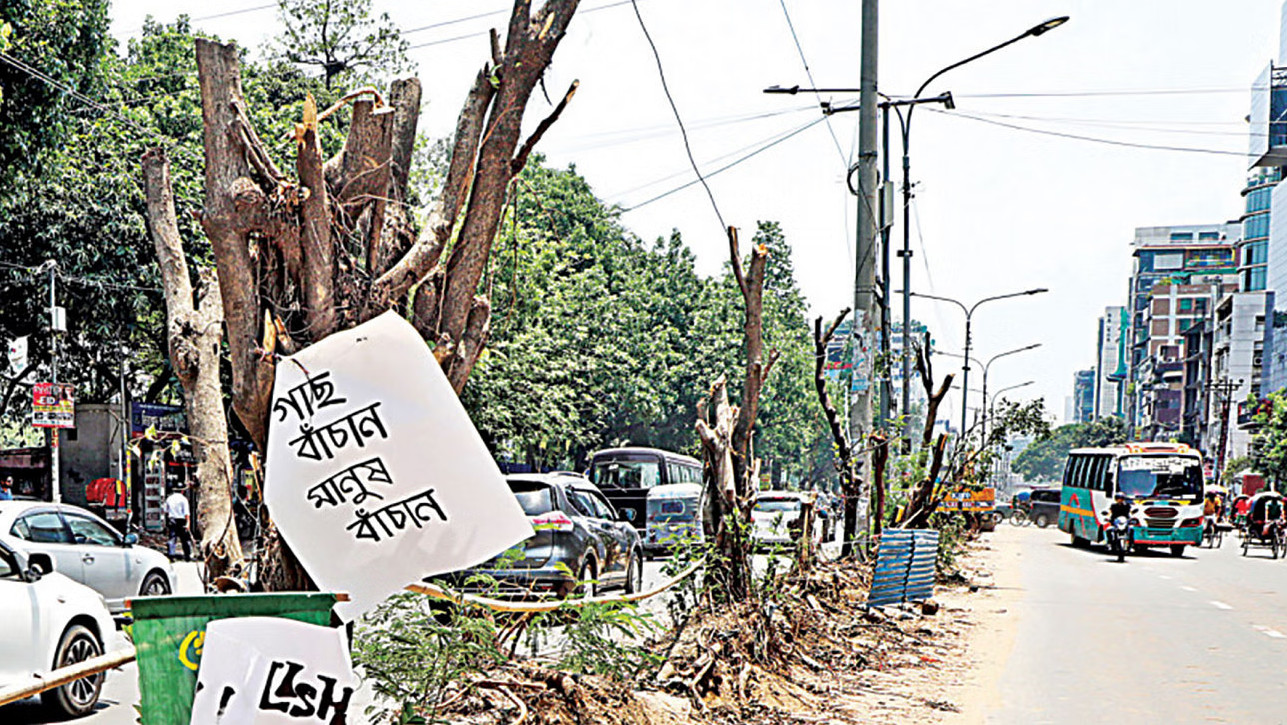
More than clever marketing, this wood embodied an entire ethos: a way for ordinary people to furnish homes, build poultry and livestock sheds, or secure microloans in a constrained economy. But just as this quiet ecosystem of livelihoods had stabilised, it was abruptly disrupted. In May, the government banned both acacia and eucalyptus, citing ecological harm. The decision left growers, carpenters, and consumers in limbo, destabilising a forestry economy built over decades.
Exotic trees are not new to Bangladesh. Teak (Tectona grandis) was introduced by the British colonial administration but remained confined to state forests for a long time. The real expansion came in the 1980s through social forestry programmes, supported by NGOs and later the Forest Department. Lacking fast-growing native alternatives, acacia and eucalyptus were promoted for their rapid growth, resilience in poor soils, and ease of maintenance, particularly in degraded areas, along embankments, and in roadside plantations. These species quickly established themselves, spreading from public lands to private homesteads, offering both green cover and economic benefits.
However, this success came with ecological trade-offs. As non-native species, they contribute relatively little to local biodiversity and have been criticised as “water-hungry.” Eucalyptus, in particular, is often accused of depleting soil moisture and releasing allelopathic toxins through its leaf litter. Yet much of this criticism is based more on public perception and environmental activism than on rigorous science. Peer-reviewed research from Bangladesh remains limited. Globally, findings are mixed: some studies suggest eucalyptus aids reforestation on degraded soils, while others warn of its hydrological and allelopathic impacts. Nevertheless, negative media coverage and activism have shaped public opinion, prompting the Forest Department to halt eucalyptus planting on public land since 2007, although private cultivation has continued.
The recent ban, however, goes further, prohibiting not just the plantation but also the transport and sale of both acacia and eucalyptus. Responses have been mixed. Rural communities that relied on these trees for furniture, fuelwood, income, and construction now face sudden precarity. Foresters, too, have questioned the rationale behind equating acacia with eucalyptus in a blanket ban. Acacia, a nitrogen-fixing species from the Fabaceae family, is often used to rehabilitate barren land and support mixed-species plantations. In marginal areas, it plays an important role in expanding green cover and meeting household needs. Allegations that acacia pollen causes asthma remain unsubstantiated, with forestry experts pointing to a lack of credible studies.
At first glance, the ban may seem like a bold ecological pivot. But on closer inspection, it reveals a deeper flaw in Bangladesh’s environmental governance: the tendency to implement sweeping decisions without rigorous research or inclusive dialogue. Despite decades of widespread planting, methodologically sound studies evaluating the long-term ecological impacts of these species remain rare. If these trees are now deemed harmful, why were they so aggressively promoted in the first place? Where are the baseline trials? Who is held accountable?
This sudden reversal illustrates what political theorist James C Scott termed the synoptic impulse: the state’s tendency to simplify complex realities into legible, administratively manageable forms. In the 1980s, the state promoted eucalyptus and acacia as miracle solutions. Now, it seeks to erase them with a single decree. In both cases, local complexities and ecological nuance are sacrificed for the promise of a uniform, scalable fix.
My conversations with villagers in Khulna and Chattogram reveal widespread frustration and confusion regarding the blanket ban. These trees are deeply embedded in rural economies—used for firewood, furniture, and even as collateral. Yet the ban was enacted without consultation, excluding those most affected: farmers, nursery owners, women who gather fuelwood, and entire communities reliant on these species. Even more troubling is the apparent class bias: teak, a slow-growing species favoured by the wealthy for high-end furniture, remains exempt—despite its well-documented ecological impacts, including soil degradation and allelopathic effects. Once again, the burden of “ecological correction” falls disproportionately on the rural poor—particularly those who followed state-backed guidance and now face penalties—while the wealthy remain untouched.
The government’s recent shift towards promoting “indigenous fruit, medicinal, and timber species” is a welcome move from the perspective of ecological restoration. However, based on past experiences, I remain wary of the risk of reproducing new monocultures—whether orderly rows of mahogany (also an exotic) or rain trees—neither of which meaningfully contributes to biodiversity. Even fruit tree culture has undergone significant transformation. What were once seed-grown, community-nurtured orchards—mosaics of mango, jackfruit, java apple, custard apple and black plum that supported rich biodiversity and fostered an ecosystem of care and support—have been replaced by a few fast-yielding clonal shrubby varieties that lack both ecological richness and cultural resonance. Today’s fruit trees are smaller, more susceptible to disease, and less hospitable to birds and pollinators. This shift reflects a forestry paradigm that prioritises market efficiency over ecological resilience and cultural heritage.
Moreover, it remains unclear whether the ban adequately considered the carbon sequestration potential of these fast-growing species, or whether it was grounded in robust and methodologically sound environmental assessments.
Yet within this rupture lies a space for possibility. The ban reopens the conversation on how forestry can be reimagined—diverse, participatory and grounded in lived realities. But meaningful change requires more than symbolic gestures. It demands institutional support for those affected: subsidies, compensation, access to credit, and above all, humility in policymaking.
Instead of a blanket ban, a more context-specific approach would involve zoning: identifying where these fast-growing species can be safely cultivated and where they should be restricted. But guidelines alone are not enough. A robust monitoring system involving forest officials, local administrations, and community members is essential to ensure adherence to zoning rules. Without such participatory oversight, even the most well-intentioned policies may falter.
In Bangladesh, trees are never just trees. They are instruments of state control, markers of class aspiration, and pillars of survival. Eucalyptus and akashmoni once symbolised progress; now they represent excess. Teak exudes elite distinction; “indigenous” species invoke nationalist pride. What is needed is not a binary of “good” versus “bad” species, but an inclusive, reflexive forestry model—one that recognises past errors, embraces ecological complexity, and shares both risks and benefits more equitably.
Dr. Mohamed Abdul Baten specialises in environmental policy, resource governance, and neoliberal impacts on marginalised communities and is a faculty member at North South University.
Views expressed in this article are the author’s own.