
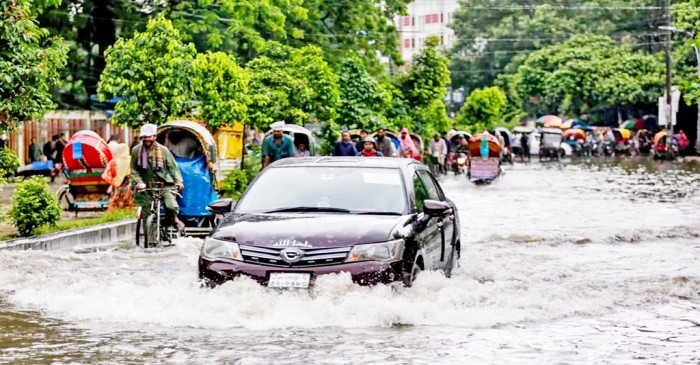

AS MONSOON clouds gather over Bangladesh’s emerald paddies, a silent force shapes the fate of its 170 million people: water, and the shifting layers of earth beneath it. From the Brahmaputra’s mighty flow in the north to the deltaic veins in the south, Bangladesh’s geo-hydrology is both its strength and vulnerability. Yet, as climate change accelerates and urban expansion surges, the need to future-proof Bangladesh’s geo-hydrological systems has never been more urgent.
Bangladesh, a country of rivers, is facing increasingly erratic seasonal cycles. The Bangladesh Meteorological Department reports a 10 per cent rise in extreme rainfall events over the past two decades. By 2050, river flows during peak monsoon could increase by up to 20 per cent, according to the Centre for Environmental and Geographic Information Services.
Sea-level rise and salinity intrusion are already stressing groundwater systems, causing arsenic contamination and depleting aquifers in urbanising areas like Dhaka and Chattogram. The interplay of groundwater depletion, land subsidence, and intensified flooding presents a complex challenge for Bangladesh’s future.
The Bangladesh Delta Plan 2100 recognises the need to manage water resources holistically for climate resilience and economic stability, calling for integrated river basin management, sustainable groundwater use, and robust flood control. Yet, unplanned urban expansion continues to encroach on floodplains and wetlands, disrupting natural recharge zones.
Unchecked groundwater extraction in peri-urban and industrial zones is accelerating land subsidence, further raising flood risks. The Institute of Water Modelling has found that Dhaka is subsiding at rates of up to 10–15 millimetres per year in some areas due to excessive extraction. Combined with rising river levels, this could turn seasonal waterlogging into chronic inundation, threatening infrastructure, health, and livelihoods.
Sedimentation in major rivers is another concern, reducing water-carrying capacity and intensifying flooding during heavy rains while restricting water availability in dry seasons. Although river dredging and sediment management projects are underway, they require long-term, science-based strategies to avoid shifting problems downstream.
Within these challenges lie opportunities. Nature-based solutions, such as restoring floodplains, reforesting watershed areas, and protecting wetlands, can strengthen Bangladesh’s natural geo-hydrological buffers. Community-led wetland restoration in Tanguar Haor and participatory river management in parts of the Jamuna basin show how local engagement, supported by scientific monitoring, can ensure sustainable water management while preserving livelihoods.
Technology can also play a critical role. Satellite-based monitoring systems and real-time hydrological data are already helping predict floods and track groundwater levels. Scaling these tools to local government planning can enhance early warning systems, reducing losses during extreme events.
Managed aquifer recharge projects in Khulna and Rajshahi are showing promise in replenishing depleted groundwater while reducing salinity intrusion during dry seasons. Investment in green infrastructure, such as permeable pavements, rainwater harvesting and urban green spaces, can help cities manage stormwater while allowing groundwater recharge.
The World Bank estimates that urban flood management in Dhaka alone could prevent damages worth billions of dollars over the coming decades, demonstrating the economic case for proactive geo-hydrological management.
Policymakers and investors must recognise that Bangladesh’s development hinges on the stability of its water systems. The Bangladesh Delta Plan 2100, supported by international climate finance, provides a blueprint to integrate flood management, sediment control and groundwater sustainability into the country’s growth agenda. However, bridging policy with action remains critical, requiring coordination across ministries, local governments, and the private sector.
Climate change is raising the stakes. Sea-level rise of 20–30 centimetres by 2050, coupled with land subsidence, could displace millions and submerge vast areas of arable land. With urbanisation projected to increase by over 50 per cent by 2050, the time to act is now to protect development gains and secure a livable future.
Future-proofing Bangladesh’s geo-hydrology is not an abstract environmental agenda; it is a matter of national security, food sovereignty and economic sustainability. It demands forward-thinking investments, community engagement and scientific innovation. As the country navigates climate uncertainties, it must ground its future in partnership with its water and land, ensuring that the dance between river, rain and soil remains a source of strength rather than vulnerability.
Dr Makhan Lal Dutta, an agricultural engineer, is chair of Harvesting Knowledge Consultancy.