
Close Menu
  • Home
  • Editorial
  • Politics
  • Economic
  • Sports
  • Religion
  • Contact us
  • About Us
Donate
Hand picked for you
  • Ethiopia, Bangladesh Commit to Deepening Ties Through Expanded Economic Cooperation – ENA English
  • Verma sees Bangladesh-India key to regional economic integration
  • Verma lauds IBCCI role in boosting India-Bangladesh economic ties | Business | FT
  • Bangladesh Economic Inequality and Oligarchs | The oligarch’s playbook: A warning for post-revolution Bangladesh
  • How BNP handles competing pressures to shape Bangladesh’s future: Crisis Group

Subscribe to Updates

Get the latest news from raznitee.

Reach out to us
  • Facebook
  • Twitter
  • Pinterest
  • Instagram
  • YouTube
  • WhatsApp
Facebook X (Twitter) Instagram
raznitee
Contact us
  • Home
  • Editorial
  • Politics
  • Economic
  • Sports
  • Religion
  • Contact us
  • About Us
raznitee
Facebook X (Twitter) Instagram
Contact us
Home»Environment»Tolerant behaviour key to reducing elephant conflict, say experts
Environment

Tolerant behaviour key to reducing elephant conflict, say experts

July 22, 2025No Comments3 Mins Read
Facebook Twitter Pinterest LinkedIn Tumblr Email
1000058129.jpg
Share
Facebook Twitter LinkedIn Pinterest Email

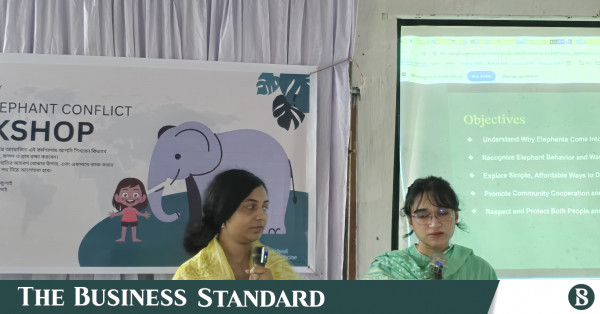
Tolerant human behaviour and a better understanding of elephant movement patterns can help reduce human-elephant conflict near wildlife sanctuaries and along traditional elephant corridors, experts said at a workshop in Chattogram on Monday (22 July).

The event, titled Human-Elephant Conflict, was held at the Chunati Wildlife Sanctuary Range Office in Lohagara upazila. It was part of academic research by Nazeeya Chowdhury, a wildlife researcher and Master of Conservation Medicine student at Tufts University, USA.

Residents from Lohagara, Banshkhali, Anwara (Chattogram), and Lama (Bandarban), all located along endangered Asian elephant corridors, joined the workshop, along with local students and officials.


The Business Standard Google News
Keep updated, follow The Business Standard’s Google news channel

Experts noted that elephants rarely act aggressively unless provoked. Blocking their traditional paths often leads to conflict, which could be avoided through informed and respectful human behaviour.

“Why are elephants coming? Because forests are shrinking,” said Nazeeya Chowdhury, explaining how deforestation and habitat loss push elephants toward human settlements in search of food and water.

“Crop fields are attractive to them as they provide easy food,” she added. Elephants often travel 10 to 70 kilometres, sometimes more, along ancestral routes in search of sustenance.

Highlighting elephants’ ecological role, Nazeeya said, “They improve soil fertility through dung and seed dispersal, create forest clearings for sunlight and new growth, and support biodiversity.”

She added, “Healthier ecosystems mean reduced disease spread and better crop yields. Elephants are emotional, family-oriented animals; they want to live in peace, just like us.”

The workshop, moderated by Sanjida Rahman of Chunati Rokkhay Amra, also heard from residents directly impacted by elephant encounters.

Farmers from Lohagara, Banshkhali, and Lama, including Rasheda Begum, Fazlur Rahman, Lakhi Akter, and Noor Hossain, described crop damage and the difficulties of accessing government compensation.

Abul Kashem from Lohagara shared, “Five years ago, I was injured when a herd passed through my field. One elephant accidentally pushed me. But I’m not afraid. I can live peacefully with them.”

Lohagara Upazila Nirbahi Officer (UNO) Saiful Islam recalled, “We saw a mother elephant carry her dead calf for three days before burying it.” He emphasised that elephants only react aggressively when their paths are blocked.

Chattogram Forest Department officer Noor Jahan warned against unplanned development. “In the name of progress, we’re destroying habitats. That inevitably leads to more conflict,” she said.

She noted that compensation is available for those affected, but many victims fail to complete the required documentation, which results in denied claims.

Share. Facebook Twitter Pinterest LinkedIn Tumblr Email

Related Posts

Climate-resilient housing models slow to gain ground in disaster-prone Bangladesh

April 6, 2026

ADB country director meets Mintoo to boost climate finance cooperation

April 6, 2026

Zero tolerance for corruption in water development board: State minister

April 6, 2026

India’s Role Seen As Vital To Bolster Bangladesh-Nepal Economic Ties

April 6, 2026
Add A Comment
Leave A Reply Cancel Reply

Subscribe to Updates

Get the latest news from raznitee.

We are social
  • Facebook
  • Twitter
  • Pinterest
  • Instagram
  • YouTube
  • WhatsApp
Latest Posts

Ethiopia, Bangladesh Commit to Deepening Ties Through Expanded Economic Cooperation – ENA English

April 23, 2026

Verma sees Bangladesh-India key to regional economic integration

April 23, 2026

Verma lauds IBCCI role in boosting India-Bangladesh economic ties | Business | FT

April 23, 2026
Follow us on social media
  • Facebook
  • Twitter
  • Pinterest
  • Instagram
  • YouTube
  • WhatsApp
Categories
  • Corruption (411)
  • Culture & Society (114)
  • Economic (1,916)
  • Environment (1,320)
  • Foreign Relations (359)
  • Health & Education (70)
  • Human Rights (5)
  • Politics (2,176)
  • Uncategorized (2)
Facebook X (Twitter) Instagram Pinterest Vimeo YouTube
  • About Us
  • Contact us
  • Disclaimer
  • Privacy policy
© 2026 Designed by raznitee.com

Type above and press Enter to search. Press Esc to cancel.