
The study, led by Md Mazharul Islam, instructor at the Bangladesh Marine Fisheries Academy, and supervised by Prof Minggang Cai at Xiamen University, compares microplastic pollution in the northern Bay of Bengal and China’s Xiamen Bay
Infograph: TBS
“>

Infograph: TBS
A recent doctoral study has found that coastal and estuarine areas in Bangladesh are more polluted with microplastics than those in China, posing a threat to marine life, human health, and pollution control efforts.
The study, led by Md Mazharul Islam, instructor at the Bangladesh Marine Fisheries Academy, and supervised by Prof Minggang Cai at Xiamen University, compares microplastic pollution in the northern Bay of Bengal and China’s Xiamen Bay.
This is the first in-depth study to look at microplastics in water, sediment, and fish tissue in these two major coastal regions. Using advanced spectroscopic tools and ecological risk assessments, the research highlights the urgent need for stronger policy action—particularly in Bangladesh—to tackle growing marine pollution.
Pollution levels higher in Bangladesh waters

The southeastern estuarine and coastal waters of Bangladesh have much higher microplastic levels than those in China. In Bangladesh, surface waters had about 560±401 microplastic particles per m³, and sediments had 130.4±62.9 particles per kg. These numbers are almost twice as high as in China’s Jiulong Estuary and Xiamen Bay, where surface water had 328±63.2 particles per m³ and sediments had 68.3±36.0 particles per kg.
In both countries, fibres were the most common type of microplastic, making up 60% of those in water and 56% in sediment in Bangladesh. Other types included fragments and lines. Polypropylene was the most common polymer in water, while acrylic dominated in sediments. Black was the most frequent colour. Most particles were between 200 and 500 micrometres in size, which means aquatic animals are at high risk of ingesting them.
Bangladesh’s fish show higher ingestion of microplastics
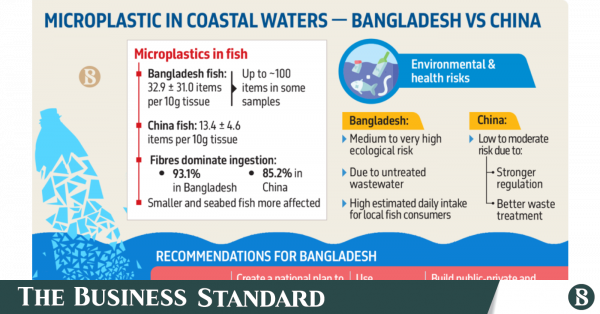
The gap between the two countries becomes more worrying when looking at microplastic ingestion in fish. Fish from Bangladeshi waters had an average of 32.9±31.0 microplastic items per 10g of tissue—more than twice the average in China, which was 13.4±4.6 items per 10g. In some Bangladeshi samples, the count reached nearly 100 items per fish.
Fibres were the most commonly ingested type, making up 93.1% of microplastics in Bangladeshi fish and 85.2% in Chinese fish. The most frequently found polymers in fish tissue were polyvinyl alcohol, polyethersulfone, polyethylene, and acrylic. Black particles were the most common colour in both countries.
The study found a clear inverse link between fish size—length, girth, and weight—and the amount of microplastics in their tissues. This means smaller fish or those that live near the seabed, like demersal species, face a higher risk of contamination.
Health and ecological risks identified
The study used three key indices to assess environmental and public health risks—the Potential Ecological Risk Index, the Contamination Factor, and the Pollution Load Index. In Bangladesh, results showed medium to very high ecological risks in estuarine and coastal areas, mainly due to untreated wastewater discharge. The Estimated Daily Intake values for adults and children eating local fish raised serious concerns about possible long-term health effects.
In contrast, ecological risks in China were lower, ranging from low to moderate. This difference is linked to China’s stronger regulatory enforcement and better waste treatment systems.
Policy gaps between the two nations
One key part of the study is its analysis of how each country responds to marine plastic pollution through policy. China has been proactive, introducing strong measures like the National Sword Policy, the Plastic Pollution Control Action Plan, and the Marine Environmental Protection Law. These efforts are supported by international cooperation with groups like the United Nations Environment Programme and the Basel Convention.
Bangladesh, although it has laws such as the Environment Conservation Act and the Marine Fisheries Act, struggles with putting them into action. Problems like weak enforcement, limited institutional capacity, and low public involvement reduce the effectiveness of these laws. Often, local pollution control relies more on community awareness and volunteer work than on formal regulations.
Recommendations for Bangladesh
The study ends with an urgent call for Bangladesh to improve its marine pollution management. A key first step is better enforcement of existing environmental laws. Creating a national action plan to reduce single-use plastics is also essential.
Bangladesh should invest in wastewater treatment systems, especially in coastal urban and industrial areas. Using biodegradable materials, expanding recycling facilities, and adopting nanofiltration systems are suggested as technological solutions. The researcher also stresses the need for public-private partnerships and regional cooperation to tackle the pollution crisis. Community-level education campaigns can help raise awareness and encourage local involvement.
Hope through innovation and collaboration
Despite the troubling findings, the study offers some hope. It highlights new innovations like biodegradable polymers, advanced waste filtration systems, and better plastic segregation technologies that could help reduce marine microplastic pollution. The study also calls for stronger cooperation between countries that share vulnerable coastlines.
Bangladesh and China, though experiencing the issue at different levels, can learn from each other. China’s governance provides examples of effective regulations, while Bangladesh offers valuable lessons from its community-based environmental efforts.
Md Mazharul Islam concludes that “protecting coastal ecosystems from the silent threat of microplastics demands urgent, coordinated, and innovative efforts—from policymakers, industries, and citizens alike.”
His research adds to global evidence that microplastics are not just an environmental threat but also a public health and governance crisis. With strategic attention and action, Bangladesh still has the chance to turn things around.