

Despite claims of thorough geological and engineering studies, the absence of published full feasibility reports or environmental impact assessments remains a concern for downstream stakeholders and environmental observers, writes Md Khalequzzaman
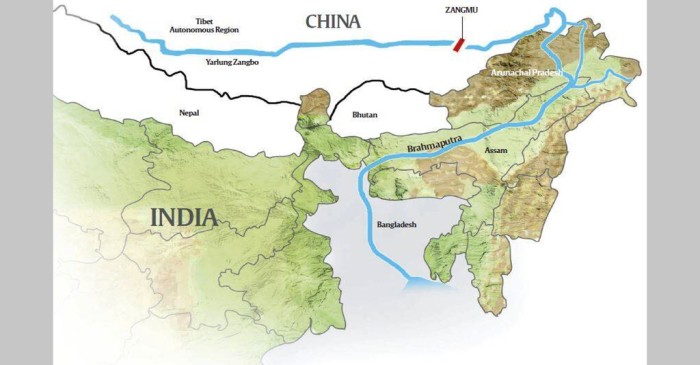
THE government of China has formally embarked on constructing what is projected to become the world’s largest hydropower dam on the Yarlung Zangbo river, known downstream as the Brahmaputra in India and Bangladesh. This mega-dam will comprise a cascade of five hydropower stations situated in Nyingchi, southeastern Tibet and will be capable of generating 60,000 MW electricity that is roughly three times the electricity that Bangladesh generates annually. The groundbreaking ceremony was attended by premier Li Qiang in July 2025. Once completed in 2033, the project cost $167 billion and will be the largest hydel station in the world. The project aligns with China’s broader energy ambitions, part of its ‘West-to-East Electricity Transfer Project,’ aiming at carbon neutrality and greater economic development in Tibet. Technical feasibility studies for the project have been referenced in Chinese state media and engineering circles, emphasising the unique topographical advantages and engineering challenges. However, detailed feasibility study documents have not been broadly circulated internationally or placed in the public domain.
There is no evidence that a comprehensive, project-specific Environmental Impact Assessment for this cascade of dams has been publicly released. Historically, for large dam projects in China, assessment documents are seldom disclosed for trans-boundary river projects. Calls for greater transparency and public participation have been voiced both domestically and by international NGOs, but disclosure has not occurred for this project as of July 2025. As per the international laws such as the UN Convention on Non-navigational Uses of International Water Courses (1997), China cannot unilaterally decide the fate of such a trans-boundary river that flow through downstream India and Bangladesh. However, none of these co-riparian nations have adopted the UN Convention (1997) as a mechanism to settle dispute on sharing of waters in trans-boundary rivers. These countries have bi-lateral treaties and memorandum of understanding to share flow information. India and Bangladesh share 54 trans-boundary rivers, but there exists a non-functional treaty to share lean period flow in the Ganges river.
India and Bangladesh have both raised strong concerns over the potential hydrological, ecological and strategic impacts on their economy and environment. A 2020 report published by the Lowley Institute, an Australia-based think tank, noted that ‘control over these rivers effectively gives China a chokehold on India’s economy.’ The Chief Minister of India’s Arunachal Pradesh Pema Khandu expressed concern that China could even use this as a sort of ‘water bomb.’ The above concerns have legitimacy. However, the irony is that India’s unilateral control of all 54 trans-boundary rivers that they share with downstream Bangladesh has been acting as a ‘chokehold on Bangladesh’s economy and environment’ the same way that they are now fearing that China’s unilateral control of the Brahmaputra river will likely do to their own country. What India has been doing to Bangladesh with the trans-boundary rivers does not justify China’s proposed project on the Yarlung Zangbo river, and Bangladesh should strongly oppose to this project. If necessary, Bangladesh should form a partnership with India to raise this concern both to China and to the International forum.
India officially protested through diplomatic communication urging China to ensure no adverse trans-bounday impact, and India is reportedly planning its own dam in Arunachal Pradesh as countermeasures. Such a counter dam will aggravate the water flow in downstream Bangladesh even further. Bangladesh has formally requested more information from China regarding the details and downstream effects of the project. Chinese authorities claim that the dam will not significantly impact downstream water flow and argue that the benefits will primarily be renewable energy supply and local economic growth. They have promised to pay ‘special attention to ecological preservation’, but have yet to offer detailed mechanism of official cross-border consultations.
Bangladesh being the most downstream country in the Yarlung Zangbo-Sian-Brahmaputra-Jamuna river watershed should be worried about any unilateral control of transboundary rivers by any upstream nation including India and China. Environmental concerns about the construction of large dams on the Yarlung Zangbo river are extensive and multi-layered, spanning ecological risks, hydrological impacts, economic loss, seismic hazards and downstream effects on the delta-building process at the face of sea-level rise caused by climate change.
Bangladesh receives about 70 per cent of lean season flow through the Brahmaputra-Jamuna river. Any uncertainty and disruption in the flow will have devastating impact on agriculture, irrigation, fisheries, navigation and fisheries. Risks of sudden large water releases (intentional or accidental), posing serious flood threats to Arunachal Pradesh, Assam, and downstream Bangladesh. Any ‘Run-of-the River’ hydroelectric project changes the pattern of natural flow regime, and the flow downstream become flashy, resulting in disruption in ecology and environment.
Large dams typically trap sediments, which can lead to riverbed degradation, loss of soil fertility, collapse of local fisheries, decline in migratory species like hilsa and mahseer that are critical for regional livelihood, intrusion of saline water in coastal regions in Bangladesh, and decline in sedimentation rates on coastal plain necessary to offset rising sea level caused by climate change. A study found that there is about 50 per cent reduction in sediment flow in the Mekong river, leading to degraded agriculture and diminished fisheries. A similar reduction in water and sediment flows prevail in the Ganges River and Teesta river in Bangladesh due to upstream damming of these rivers. In 1960s, the trans-boundary rivers used to carry over 2 billion tons of sediments to Bangladesh annually, which has declined to about 1 billion tons in recent decades. Dams reduce downstream sediment supply, increasing erosive power of water and interrupting the natural land-building process needed to stabilise riverbanks and the delta in Bangladesh. Increased rates of riverbank erosion in recent decades along the major rivers in Bangladesh, such as the Brahmaputra-Jamuna, Ganges, Teesta and Meghna have been reported by many researchers.
While some Chinese studies suggest dams may stabilise flows by releasing more water in dry seasons and holding back floods during the monsoon, Indian officials and hydrologists dispute this, warning that upstream control could worsen floods or create sudden droughts through deliberate or accidental releases, particularly during political tensions or emergencies. The Brahmaputra is a vital source of water for drinking, irrigation and hydropower for millions in India and Bangladesh. Officials in India’s border state of Arunachal Pradesh have stated concerns that the Chinese dams could ‘dry out 80 per cent of the river passing through the Indian state,’ thereby threatening regional water supplies and agricultural livelihood, while also potentially causing massive floods if water is suddenly released. The lack of water-sharing agreements among the co-riparian countries or transparent data exacerbates these risks for downstream users.
Despite claims of thorough geological and engineering studies, the absence of published full feasibility reports or environmental impact assessments remains a concern for downstream stakeholders and environmental observers. The dam is located in one of the world’s most seismically active regions, near the site of the devastating magnitude 8.6 Assam-Tibet earthquake of 1950. Experts warn that a strong earthquake or landslide could create catastrophic dam failures with downstream consequences, not only for ecology but also for human settlements and farmland.
In light of the current situation, a proper and technical response by the government of Bangladesh to China’s proposed Hydropower Station should be multi-layered, assertive, and grounded in international water law and trans-boundary river best practices. Drawing from expert commentary, global precedents and responses by Bangladesh so far, the following 10 steps are recommended by this author: (a) reiterate and expand formal request to China for release of detailed technical documents, specifically the EIA, Feasibility Study, Climate Impact Assessment, and Disasters Impact Assessment; (b) actively pursue tripartite engagement — including India, the midstream country — for joint risk assessment and response planning on the Brahmaputra system; (c) propose or join a basin-wide river management initiatives including China, India, Bangladesh, Bhutan, and possibly Nepal, to ensure all stakeholders’ concerns are addressed before project commissioning; (d) expedite ratification of the 1997 UN Convention on the Law of the Non-navigational Uses of International Watercourses to enhance Bangladesh’s standing as the lowest riparian state and leverage international legal norms for equitable and reasonable use; (e) explore options for legal arbitration or reference to international dispute resolution mechanisms if adequate information or mitigation is not assured; (f) take up a project independently study potential impact of the project on Bangladesh by international and local experts; (g) build alliances with regional and transnational NGOs advocating for equitable and fair trans-boundary river management; (h) Accelerate internal measures to enhance irrigation efficiency diversify water sources, and bolster riverine ecosystem resilience to anticipated changes in Brahmaputra flow; (i) proactively brief media, water experts, and civil society regarding the risks and government actions, increasing international visibility and consensus for Bangladesh’s position; (j) promote ecological approach to water resources management at all scales for domestic rivers.
Md Khalequzzaman is a professor of geology at the Commonwealth University.