
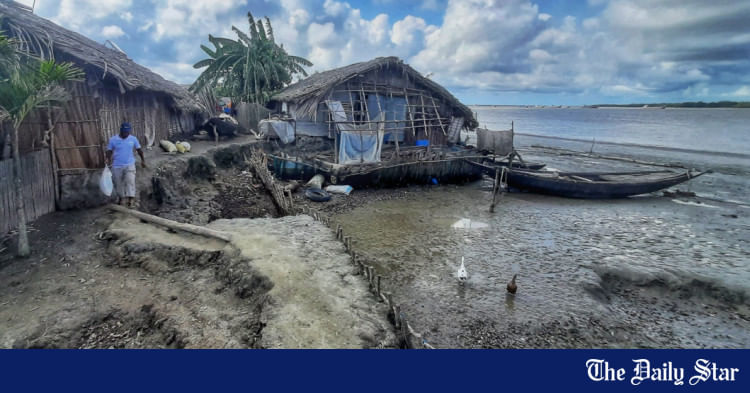

Bangladesh is not doing well in taking strong climate action in the health sector through effective policies, plans or finance. FILE PHOTO: HABIBUR RAHMAN
“>
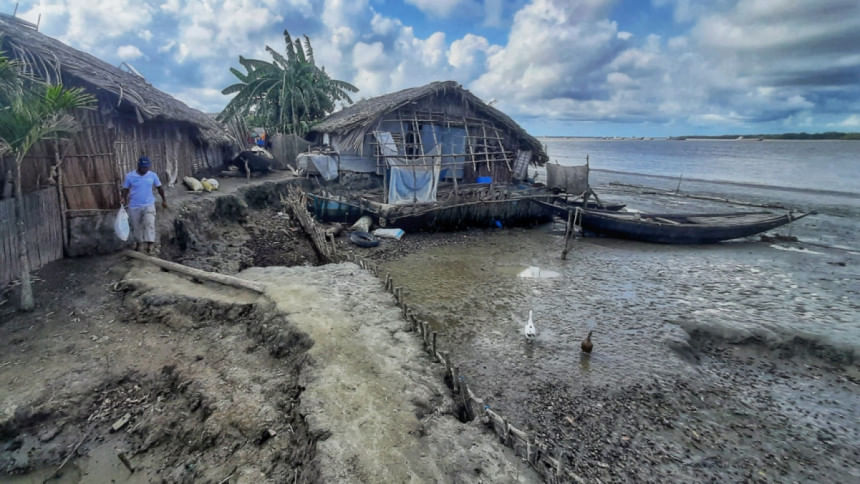
Bangladesh is not doing well in taking strong climate action in the health sector through effective policies, plans or finance. FILE PHOTO: HABIBUR RAHMAN
In the development discourse, one of the most overused terms is probably “mainstreaming.” Over the past 25 years, Bangladesh has invested billions of dollars in mainstreaming community-based approaches, gender equity and climate change adaptation, for example, through thousands of development projects. However, while health is a human right, has it been mainstreamed in our climate change policies and actions?
Till now, the Bangladesh Climate Change Strategy and Action Plan (BCCSAP, 2009) has been our most treasured climate change policy instrument. It has 44 programmes grouped under six themes. The first theme is “Food Security, Social Protection and Health,” which includes “Adaptation in health sector” as one of its nine programmes. This health programme has three basic purposes: i) to conduct research and monitoring of climate change impacts on disease patterns (of malaria, dengue, diarrhoea and heatstroke); ii) to estimate the social and economic costs of such diseases; and iii) to formulate measures to adapt to climate change impacts. However, the BCCSAP programmes were essentially research-focused.
 For all latest news, follow The Daily Star’s Google News channel.
 Thirteen years on, Bangladesh achieved another milestone by formulating the National Adaptation Plan (2023-2050), popularly known as the NAP. Many of us may think that, given the climate change impacts on the health sector, the NAP may have emphasised health significantly. But health issues have barely been touched on in some of the six goals of NAP. Under Goal 3, climate-resilient healthcare and water, sanitation, and hygiene (WASH) facilities will be developed to improve human well-being and liveability in urban areas, while Goal 6 expects technological innovations in health and WASH to fight climate change. While the plan has also identified 113 interventions costing a total of $230 billion by 2050, only three interventions are directly linked to health. Speaking of finance, these three interventions would cost only 1.36 percent of the total NAP budget.
Apparently, the main reason for the NAP’s low focus on health is the draft Bangladesh Health-National Adaptation Plan (HNAP). This reasonable five-year plan was drafted by the Institute of Epidemiology, Disease Control and Research (IEDCR) and the World Health Organization (WHO) in 2018. Now, more than seven years later, it is still a draft. So, Bangladesh has efficiently missed the opportunity to strategise adaptation in the health arena twice in the last seven years. But we were not supposed to be facing this disappointment because the country’s National Health Policy 2011 made “monitoring climate-induced health disasters and prevalence and patterns of related diseases, and developing measures to address these” as one of its 19 primary goals, and related that goal with relevant principles and strategic actions 14 years ago.
Since FY2016, the Bangladesh government has been preparing climate budgets for 25 ministries, departments, and divisions. The total allocation for climate-relevant interventions for FY2026 is Tk 41,208.97 crore—5.2 percent of the total national budget and 0.66 percent of the GDP. The Health Services Division (HSD), representing the health ministry, received Tk 610.22 crore, which is only 1.48 percent of the total climate budget of FY2026. Further, it is only 1.97 percent of the HSD’s total budget, making it the fifth-lowest proportion among all 25 agencies.
Another way to track climate-related investments in the health sector is the disbursement of the Bangladesh Climate Change Trust Fund (BCCTF). The trust allocated Tk 3,831.68 crore (2010-2024) to 877 projects under 21 ministries and divisions. To implement three projects, the HSD received Tk 22.12 crore, which is only 0.58 percent of the BCCTF’s allocation till December 2024.
Therefore, Bangladesh is not doing well in taking strong climate action in the health sector through effective policies, plans or finance. We need to shift our way of seeing health in the climate change context. As the era of climate change-induced losses and damages has already begun, we have to bring that lens into our health sector. We have delayed taking adaptive measures in the health sector due to institutional, policy, legislative and financial constraints, creating a significant gap in adaptation, which will continue causing losses and damage. We may think that physical and mental health-related loss and damage are only non-economic issues. However, illness due to heatwaves or loss of limbs during cyclones not only affects physical and mental well-being, causing non-economic losses, but it also leads to economic damages by reducing household income and saving. On the other hand, damage of crops or fish in the ponds due to floods is not only an economic loss, but it also affects the mental health of the family members as well as their physical health due to lower food security.
It is high time the environment, health, planning, and finance ministries came together to comprehensively plan how to deal with climate change-induced losses and damages in the health sector to fill in the adaptation void we have created over the years. In transdisciplinary research, the core problem gets the focus, not the academic disciplines involved in solving it. We now need “trans-ministerial” climate action for the health sector.
Dr Haseeb Md. Irfanullah is an independent environment and climate change consultant and visiting research fellow at the University of Liberal Arts Bangladesh (ULAB). He can be reached at [email protected].
Views expressed in this article are the author’s own.
Follow The Daily Star Opinion on Facebook for the latest opinions, commentaries and analyses by experts and professionals. To contribute your article or letter to The Daily Star Opinion, see our guidelines for submission.