
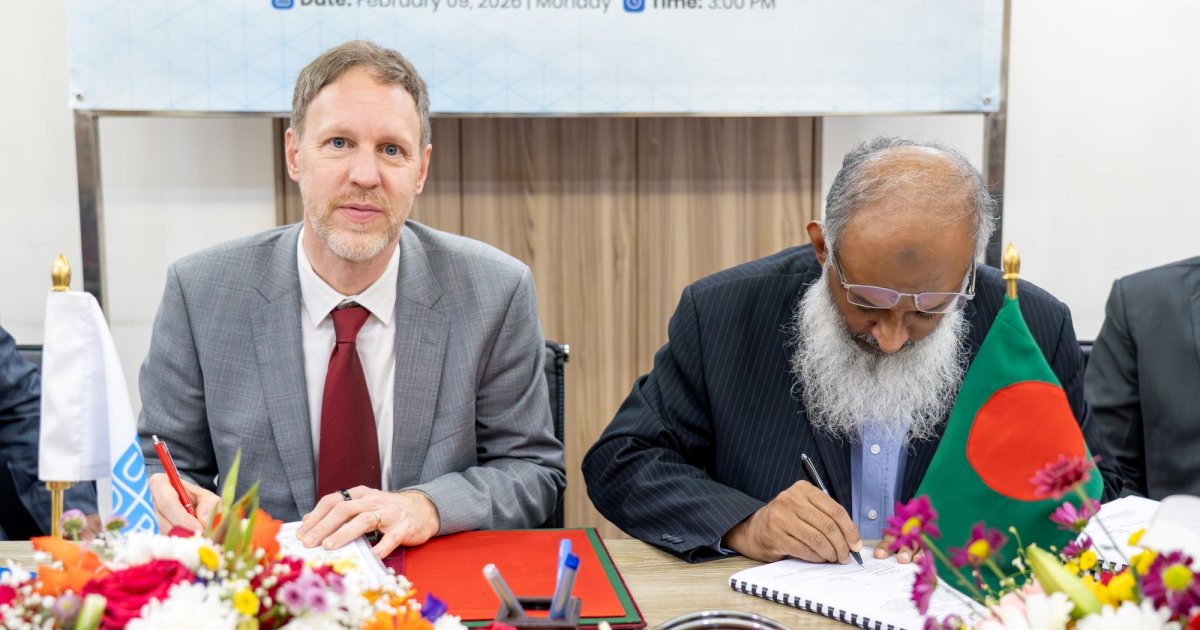
The Economic Relations Division (ERD) of the Ministry of Finance and the United Nations Development Programme (UNDP) signed two projects—Transformative Economic Policy Programme (TEPP) Phase II and Institutional Strengthening for Promoting Accelerated Transformation (ISPAT)—at ERD on Monday.
Md Shahriar Kader Siddiky, secretary of ERD, and Stefan Liller, UNDP resident representative in Bangladesh, signed the agreements on behalf of their respective institutions.
TEPP II, running from January 2026 to March 2028 with a total budget of approximately US $3.57 million funded by the UK Government, aims to strengthen Bangladesh’s trade and investment policy ecosystem. The project will support a competitive post-LDC transition by enhancing trade negotiation capacity, evidence-based policy analysis, institutional reforms, and investment climate processes through the Ministry of Commerce (MoC) and the Bangladesh Investment Development Authority (BIDA).
ISPAT, scheduled from January 2026 to June 2027 with a budget of $1.06 million supported by the Australian Government, seeks to modernize the NGO Affairs Bureau. The project will introduce digital systems, improve transparency, promote gender-responsive service delivery, and implement policy reform and capacity development to enhance NGO oversight and engagement in national development priorities.
Commenting on the initiatives, Md. Shahriar Kader Siddiky said: “These projects reflect our commitment to institutional strengthening—building capacity, enhancing transparency and accountability, and fostering evidence-based policymaking. They will help develop confident, capable institutions and professionals who can effectively support good governance and Bangladesh’s economic transformation during the post-LDC transition.”
Stefan Liller added: “These two projects are highly strategic and catalytic, strengthening the institutions and policy ecosystems that underpin Bangladesh’s economic transformation and governance reforms. UNDP remains committed to supporting nationally led, forward-looking reforms that will deliver long-term impact.”
The signing reaffirms the partnership between the Government of Bangladesh, UNDP, and development partners in advancing the country’s economic transition, strengthening public institutions, and promoting transparent, technology-enabled, and citizen-centric service delivery. Both TEPP II and ISPAT are expected to bolster governance systems, foster private sector competitiveness, and support Bangladesh’s progress toward the Sustainable Development Goals (SDGs).
The event was attended by senior officials from ERD, NGO Affairs Bureau, BIDA, Ministry of Commerce, the Australian High Commission, and UNDP, including A K M Sohel, Additional Secretary & Wing Chief (UN), ERD; Md. Daud Miah, Director General (Additional Secretary), NGO Affairs Bureau; Md. Muzib-Ul-Ferdous, Director General (Additional Secretary), BIDA; Mohammad Khairul Alam, Deputy Chief (Export Wing), MoC; Syed Haider, First Secretary & Head of Development Cooperation, Australian High Commission; Asif Kashem, Senior Programme Manager, Australian High Commission; Anowarul Haque, Assistant Resident Representative, UNDP; and Sheela Tasneem Haq, Senior Governance Specialist, UNDP.