
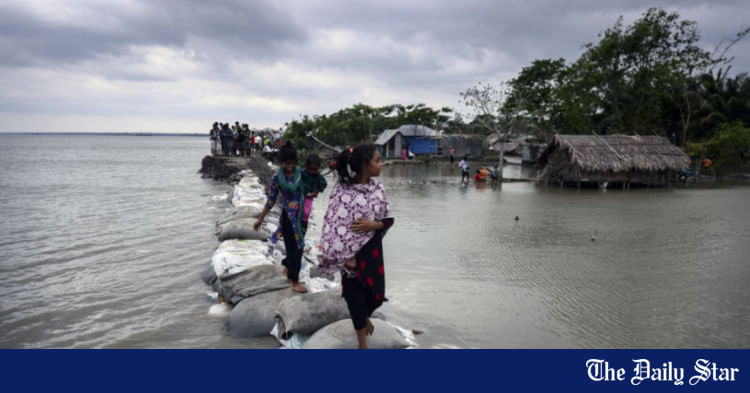
More than half of households in Bangladesh’s coastal belt report struggling to cope with rapid climate change, citing a lack of adequate disaster-protection infrastructure, according to a new World Bank survey.
When asked, 57 percent of households identified inadequate embankments, cyclone-resistant structures, and protective infrastructure as the biggest long-term barrier to building climate resilience.
 For all latest news, follow The Daily Star’s Google News channel.
 In response to another question, 56 percent of households said financial constraints remain a major obstacle to implementing more effective adaptation measures.
“The impacts are not just environmental but deeply human, as poor and agricultural households are disproportionately affected,” the Washington-based lender notes in its report.
The survey, conducted across 250 coastal villages in 2024, is part of the World Bank’s new report, “From Risk to Resilience: Helping People and Firms Adapt in South Asia,” unveiled yesterday at the InterContinental Dhaka.
South Asia, with its dense population, high temperature, and exposed geography, is one of the world’s most climate-vulnerable regions, and Bangladesh is among the most at risk.
“By 2030, nearly 90 percent of the region’s population will be at risk of extreme heat and nearly a quarter at risk of severe flooding. With an increase in water and soil salinity in the coastal regions, the climate crisis is severely impacting millions of lives in Bangladesh,” highlights the WB report.
According to the survey, more than three-quarters of households show strong awareness of climate risks, expecting a significant weather shock in the coming decade.
Already, 80 percent of households have taken action — but most rely only on low-cost, basic solutions due to lack of access to advanced technologies, credit, or climate-resilient public infrastructure.
The consequences are particularly severe for the poor and for agriculture-dependent families, who are losing land, crops, and income as salinity, flooding, and extreme heat intensify.
For the past 10 years, almost 75 percent of coastal residents in Bangladesh have reported experiencing flooding, which the report notes is lower than satellite-based estimates of around 90 percent.
The reported worst flood was about 40 centimetres deep, and it took about a week for the water to recede.
According to satellite data, in coastal Bangladesh, the average household was flooded 19 times during 2000-2018, or roughly once a year.
While Bangladesh’s investments in cyclone shelters and embankments have historically saved thousands of lives, the report warns that fiscal constraints are limiting the government’s ability to scale up infrastructure at the pace demanded by climate impacts.
The report argues that private-sector-led adaptation will be crucial, estimating that up to one-third of climate-related losses could be avoided if corporate firms can shift resources and investments more quickly in response to climate pressures. Improving access to credit, insurance, transport networks, and digital connectivity is essential to enable that transition.
“Bangladesh’s resilience is being continually tested by evolving environmental challenges… more needs to be done,” said Jean Pesme, World Bank division director for Bangladesh and Bhutan.
While speaking at the report unveiling event, he emphasised the need to expand early warning systems, social protection, climate-smart agriculture, and adaptation finance, including innovative risk-finance tools.
At a panel discussion, Prof Sharmind Neelormi of Jahangirnagar University said, “Climate-resilient infrastructures are now a critical issue, and our leadership must think seriously about how to address it.”
“In the Eighth Five-Year Plan, we placed strong emphasis on infrastructure, but with the Ninth Plan still on hold, many of these priorities remain unresolved,” she added.
Bangladesh needs nearly $12 billion a year for adaptation and mitigation, but the government can provide only about $3.5 billion, said Farhina Ahmed, secretary of the Ministry of Environment, Forest and Climate Change.
“The country also requires innovative financing and stronger private-sector participation.”
“Adaptation is often unattractive for private investors, so we must rethink how to mobilise financing. Each investment must generate multiple benefits,” she added.