
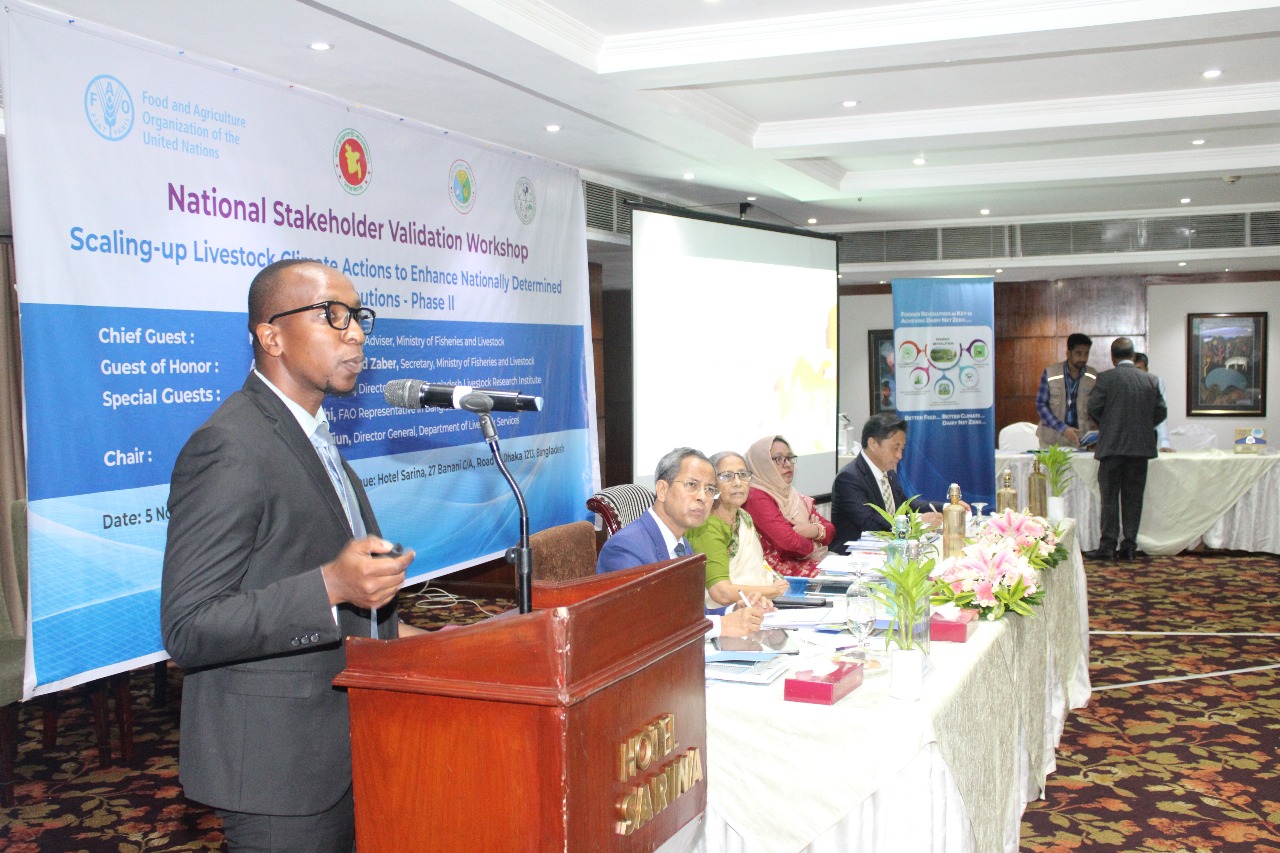
The Food and Agriculture Organization of the United Nations (FAO), in collaboration with the Ministry of Fisheries and Livestock (MoFL) and the Bangladesh Livestock Research Institute (BLRI), is organizing a national stakeholder workshop to review and validate the results of a series of technical studies on greenhouse gas (GHG) emissions, policy coherence, and mitigation strategies in the livestock sector of Bangladesh.
Taking place in Dhaka on 5 November 2025, the workshop is part of the FAO Flexible Voluntary Contributions (FVC) Subprogramme “Scaling up livestock climate actions to enhance nationally determined contributions (NDCs) – Phase II”.
Strengthening climate action in Bangladesh’s livestock sector
Bangladesh has demonstrated strong commitment to climate action through its nationally determined contribution (NDC 3.0), which includes specific targets for reducing methane emissions across sectors — including livestock. The livestock sector, a cornerstone of rural livelihoods and food security, contributes about 1.83% to the national GDP and 16.35% of agricultural GDP. It employs nearly 20% of the population full-time and 50% part-time.
However, the sector also accounts for a significant share of greenhouse gas emissions, in particular methane, mainly from enteric fermentation and manure management systems. To help the country meet its emission reduction targets, FAO and BLRI developed national and sub-national Tier 2 GHG inventories, identified cost-effective mitigation options, and conducted a policy coherence analysis to assess how existing frameworks support climate-resilient livestock systems.
About the workshop
The Dhaka workshop brought together around 90 participants from ministries, government departments, academia, civil society, and development partners, including the Ministry of Fisheries and Livestock (MoFL), Department of Livestock Services, Department of Environment, Planning Commission, Bangladesh Agricultural Research Council, World Bank, universities, Heifer International, and local development partners.
Participants will review three key outputs:
- The Livestock, Environment and Climate Policy Coherence Analysis report
- The Sub-national and National Cattle GHG Emissions Quantification report
- The Manual on Livestock GHG Mitigation Technologies and Good Practices
The workshop will provide a platform for multi-stakeholder dialogue to strengthen collaboration, validate findings, and agree on recommendations to support a low-emission and climate-resilient development of the livestock sector nationally.
Advancing Bangladesh’s NDC implementation
By validating these technical analyses, the workshop represents a crucial milestone in Bangladesh’s journey toward implementing its NDC commitments. The validated results will support evidence-based policymaking, guide the transition from Tier 1 to Tier 2 emission accounting, and promote the integration of climate-smart livestock practices into national strategies and plans.
The continued collaboration between FAO, BLRI and national partners reinforces Bangladesh’s leadership in livestock-based climate action, contributing to the country’s Vision 2041 for sustainable, inclusive development and resilience to climate change.