
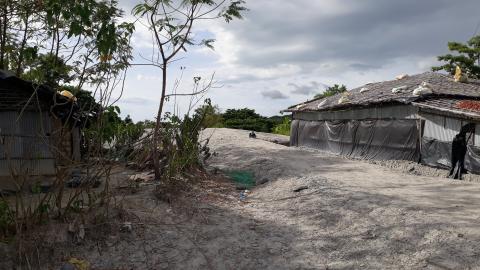
Coastal communities bear some of the harshest and most immediate consequences of climate change, especially those in poorer countries in the Global South. In Bangladesh, which places seventh on the global Climate Risk Index, the southeastern shoreline communities of Cox’s Bazar and Chittagong are especially vulnerable. Particularly during the rainy season, they face frequent cyclones, storm surges and severe flooding with attendant coastal erosion.
All these effects are visited on a population with inadequate infrastructure and little access to resources. The area houses the world’s largest refugee camp, Kutupalong, which with its neighboring informal camps houses over 931,000 people, mostly Rohingya Muslim refugees fleeing from persecution in the neighboring country of Myanmar. Even those residents who are not refugees live barely above the poverty level, and many depend on fishing for their livelihoods—a profession threatened by increased salinity, environmental pollution and the depletion of marine resources.
A new project co-led by the George Washington University’s Global Women’s Institute (GWI) will help give insight into how Cox’s Bazar and similar communities can build resilience against the effects of climate change. “Building Resilience of Coastal Inhabitants in Vulnerable Regions of Bangladesh Through a Participatory, Gender-transformative Approach” is a winner of the Canada-led 2023 International Joint Initiative for Research in Climate Change Adaptation and Mitigation competition, receiving about $525,000 from the National Science Foundation.
“It’s crucial for us to look at climate change with a gendered perspective, because women are often bearing the brunt of the impacts of climate change ” said Maureen Murphy, a GWI research scientist and co-principal investigator of the project. “So, we want to make sure that their perspective is pushed forward and that we’re designing adaptation and mitigation strategies with their realities in mind.”
As an example, Murphy pointed to water collection, a task generally allocated to women. If it takes hours to reach and collect clean water, women have to structure their days around that single task just to ensure their families’ survival.
Like much of GWI’s defining research, the project is characterized by its community-centric, participatory approach, Murphy said. GWI’s co-principal investigators come from the Bangladesh Centre for Advanced Studies, Jago Nari Unnayon Sangstha (JNUS), a women-led Bangladeshi nonprofit, and researchers from University of the Fraser Valley in Canada. They will work with community members not as “subjects” of research, but as “co-researchers”—colleagues in a mutually educational and beneficial relationship. In Phase I, which begins this summer, the team and co-researchers will focus on data collection, collaboratively identifying the greatest risks the community faces due to climate change. They’ll use cooperative, arts-based methodologies like storytelling, photography, mapping and drawing and will use an intersectional lens to ensure that the concerns of women and people with disabilities lie at the center of the work.
“The idea is that this is not an extractive data collection process, but something very interactive,” Murphy said. “We’re trying to reduce the power imbalances between the researchers and the communities, and to make it more of just a partnership where we’re all learning and trying things out in a very collaborative spirit.”
Once researchers have identified the practical concerns that community members are facing in light of the changing climate, they’ll analyze their findings to identify community-based mitigation strategies that are both responsive and realistic. These strategies will be piloted within their communities and lessons learned from this process will be shared globally to encourage the adaptation of these strategies in other areas affected by climate change.
Murphy said the project will also empower its on-the-ground partners, providing an opportunity for JNUS researchers in particular to develop their skills and deepen their experience as full, start-to-finish research partners. The organization first worked with GWI on a project studying and combating gender-based violence within refugee settlements in Bangladesh. Now, they’ll take the lead on participatory data collection, qualitative data analysis and other complex tasks. And they’ll pass those skills on to other community members.
“One very positive aspect of this partnership is that it’s a complex project with many different actors, and we’re focused on making sure we center this community in a real way that’s not performative,” Murphy said. “Our role is really to provide technical support, to bring that global perspective and suggest best practices. But we’re really giving the space for the project to be led by the people in the communities and our Bangladeshi co-PIs.”