
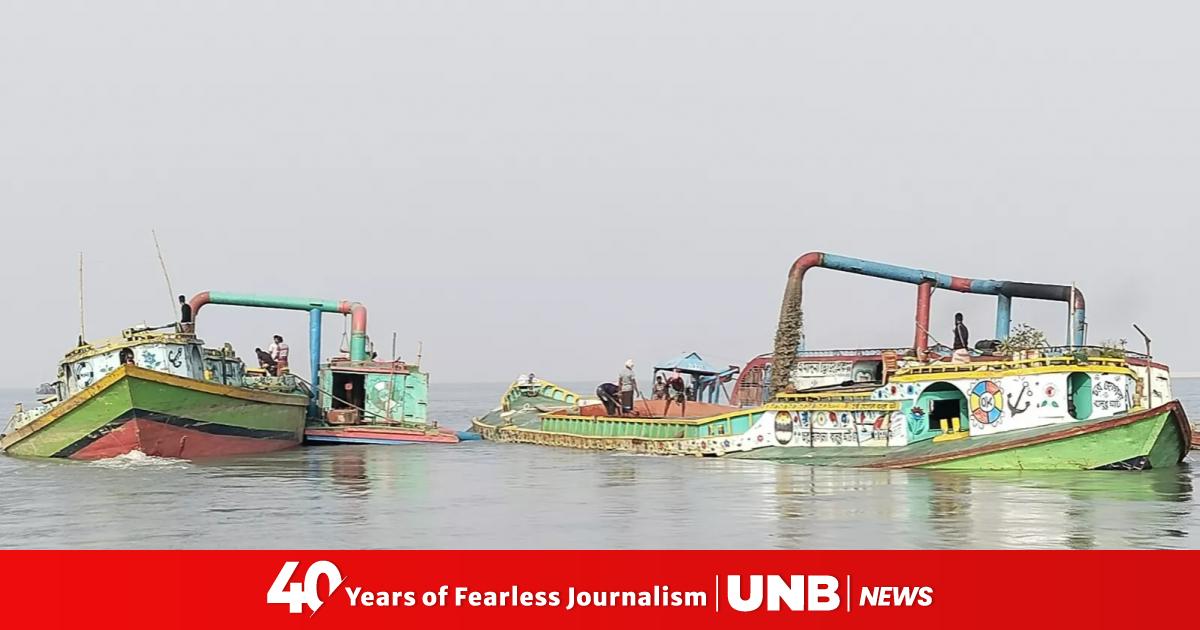
Illegal sand lifting and trading is rapidly expanding in Bangladesh, emerging as a lucrative but highly damaging enterprise due to inadequate administrative oversight and weak regulatory enforcement.
Despite its widespread use in both private and government construction projects, the sector largely operates outside the legal framework, with enforcement efforts falling short.
Dr Adil Mohammed Khan, President of the Bangladesh Institution of Planners (BIP), told UNB, “The government has to make a massive plan to bring the sand business and sand lifting under control to save the environment, rivers and agricultural land.”
Thousands of people are engaged in both legal and illegal sand businesses.
Zia Uddin, a sand trader from Keraniganj and owner of Zia Trading, which has been involved in the sand and stone trade for over 25 years, said most traders are not officially registered. “In some cases, local governments and deputy commissioners provide leases to lift sand,” he added.
Zia also pointed out the dominance of politically influential individuals in the illegal trade, which is estimated to be worth several thousand crores of taka. “Sand is a crucial resource for construction and infrastructure development in Bangladesh, leading to high demand,” he said.
Rising Prices and Growing Market
Data from the Bangladesh Bureau of Statistics (BBS) reflect the increasing value of sand.
In June 2024, the wholesale price in Dhaka stood at Tk 2,800 per 100 cubic feet, with a nationwide average of Tk 2,960. Prices have fluctuated over the years, with the lowest recorded in July 1994 at Tk 425 per 100 cubic feet, and a high of Tk 3,400 in August 2023.
Different types of sand fetch different prices. For example, yellow Sylhet sand is more expensive than white sand.
DCs asked to stay vigilant about illegal sand extraction from rivers
In 2020, white sand in Dhaka’s largest sand market sold for around Tk 1,500 per truck, while yellow sand fetched up to Tk 7,000.
Market Scale and Informality
Liakat Ali Bhuiyan, Senior Vice-President of the Real Estate and Housing Association of Bangladesh (REHAB), cited a 2023 study estimating Bangladesh’s annual sand requirement at seven crore tonnes, valued at approximately Tk 35,000 crore.
“This represents a sevenfold increase from the estimated market value of Tk 5,000 crore prior to 2010. This market volume is continuously growing,” he said.
But, a significant portion of this market remains informal. Estimates suggest that 60–70 per cent of the sand is extracted illegally from rivers, often without environmental or hydrological considerations, making the true scale of the trade difficult to determine.
Methods of Illegal Extraction
· Illegal sand lifting is prevalent across rivers, canals, wetlands, and even reserve forests. Common methods include:
· Dredging: High-capacity, locally made diesel-powered dredgers are used to extract large volumes of sand.
· Manual Lifting: Labourers often use small boats to lift sand by hand.
· Land Excavation: Sand is also illegally mined by excavating land near rivers or in protected areas, causing severe habitat destruction.
These operations are often conducted openly and with impunity, especially where influential individuals are involved. While mobile court raids are occasionally carried out, illegal activities frequently resume soon after.
Illegal sand extraction exacerbating riverbank erosion, threatening lives in Manikganj
Legal Framework and Enforcement Gaps
The key legislation regulating sand extraction in Bangladesh is the Balu Mohal O Mati Bebosthapona Ain (Sand Fields and Soil Management Act), 2010. It includes several important provisions:
· Extraction Prohibited in Sensitive Areas: Sand lifting is banned within one kilometre of critical infrastructure such as bridges, culverts, dams, roads, and residential zones. It is also prohibited inside forests without explicit permission from the forest department, as per the Forest Act.
· Permit Requirements: Legal extraction requires permits from the relevant authorities. The government may declare certain zones as designated sand quarries.
· Environmental Oversight: While the Act considers environmental concerns, it does not mandate environmental impact assessments (EIAs) for all projects, a loophole critics say weakens safeguards.
· Penalties: Offenders may face up to two years’ imprisonment and fines of up to Tk 10 lakh. Mobile courts can try these offences. However, the fact that these offences are both bailable and compoundable undermines enforcement, according to activists.
Task force conducts operation against illegal sand extraction in Feni river
Environmental and Socio-Economic Consequences
The environmental impact of illegal sand lifting is both severe and wide-reaching:
· Riverbank Erosion: Sand removal destabilises riverbanks, accelerating erosion and displacing communities.
· Damage to Infrastructure: Structures such as bridges and embankments face weakening due to undermined foundations.
· Habitat Destruction: Riverbeds and sandbars that support biodiversity are damaged, threatening aquatic life and fish production.
· Altered River Morphology: Changes in river flow and bed depth increase flood risks and affect groundwater.
· Water Quality Degradation: Increased turbidity harms aquatic ecosystems and reduces water usability.
· Loss of Agricultural Land: Reduced water tables and soil moisture negatively affect crop yields.
· Impact on Forests: Illegal sand mining near forests leads to deforestation and further environmental degradation.
Calls for Reform and Stronger Enforcement
26 dredging machines seized for illegal sand extraction from Feni River
Although mobile courts and local administrations occasionally seize dredgers and fine violators, enforcement is insufficient to stem the tide of illegal activity.
Environmentalists and community activists are calling for amendments to make offences non-bailable, stricter law enforcement, and enhanced transparency in the sand mining sector.
The continued growth of illegal sand lifting poses not only an environmental and infrastructural threat but also undermines government revenues and the rule of law.